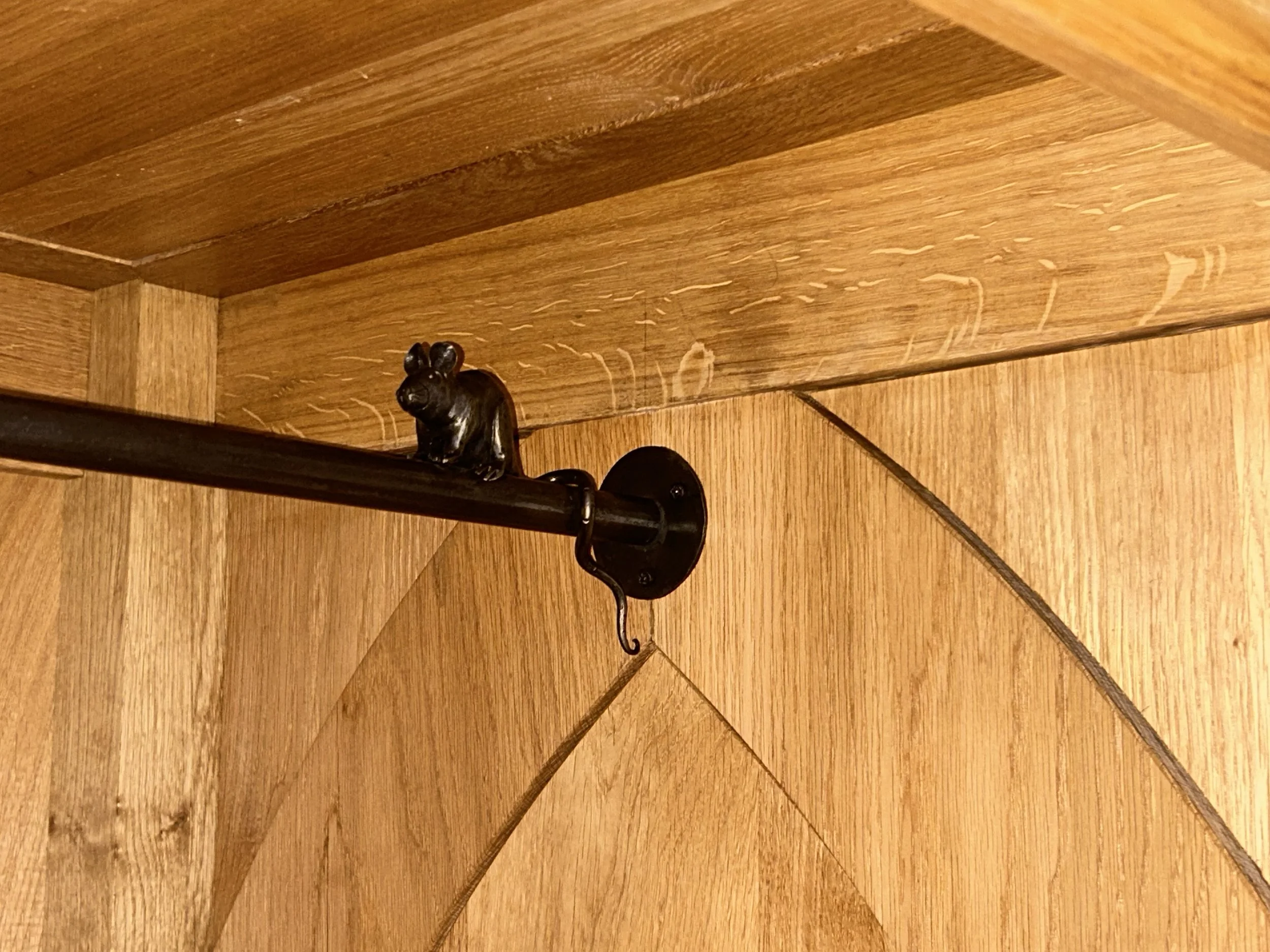
The Mouse, the Priest and the Wardrobe.
I didn't go looking for this commission. It found me in a pub.
A man approached me one evening — a stranger, or so I thought. He had kind eyes and a quiet manner and he asked me directly: "Aren't you the furniture maker?"
I was puzzled. I'd hardly told anyone locally that I made furniture. I certainly didn't recognise him. So, I asked how he knew.
It turned out we'd met before, briefly, on a lane near his cottage. I'd been walking past with my dog Dougal — a distinguished, sometimes grumpy fourteen-year-old Irish Terrier who has strong views about which routes we take and which strangers deserve his attention. Apparently on that occasion he'd approved of this particular stranger, because we'd stopped and talked for fifteen minutes before moving on.
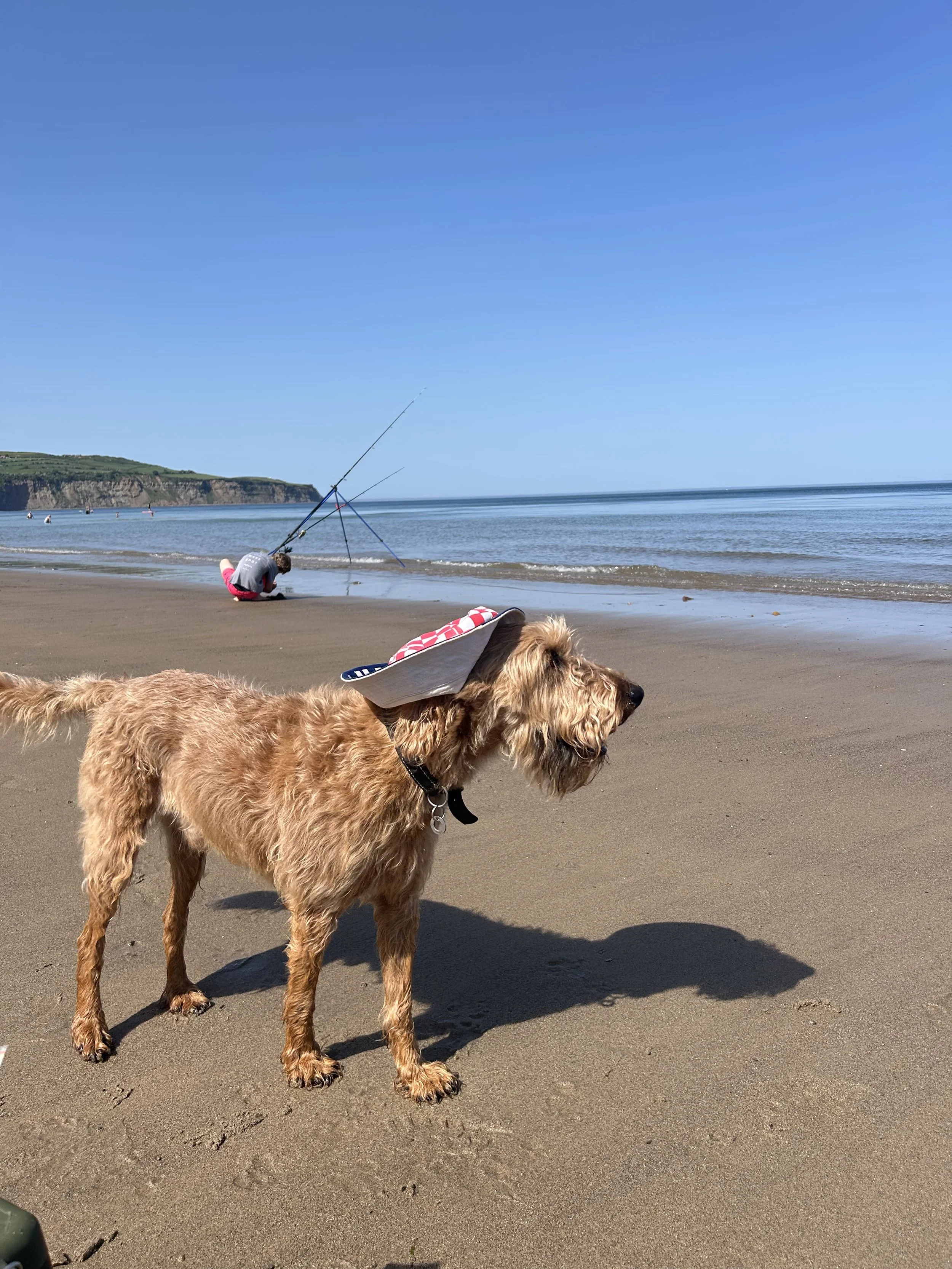
Wherever I lay my hat that’s my home.
I had no memory of it. He remembered everything.
Rev. Michael Waters was a retired Church of England priest. Ninety something years young. And he wanted to commission a wardrobe.
He asked if I'd be interested. I said I'd go away, think about it, and come back with some drawings. What I didn't tell him was that the moment I got home, I was terrified.
This was bigger than anything I'd made before. More demanding than anything I'd attempted. It was possibly a little outside my comfort zone. But I did the drawings. He liked them. And somehow, somewhere between the pub and the pencil, I'd committed.
I always ask my clients to be involved in the whole journey, not just the destination. Not just a finished piece delivered to a door. I want them present in the decisions, the progress, the problems. Michael visited the workshop several times during the making. Every single visit left me anxious. There's no other word for it. When you make something entirely by hand, every visit from a client is an exposure. Your judgement, your ability, your doubt — all of it visible.
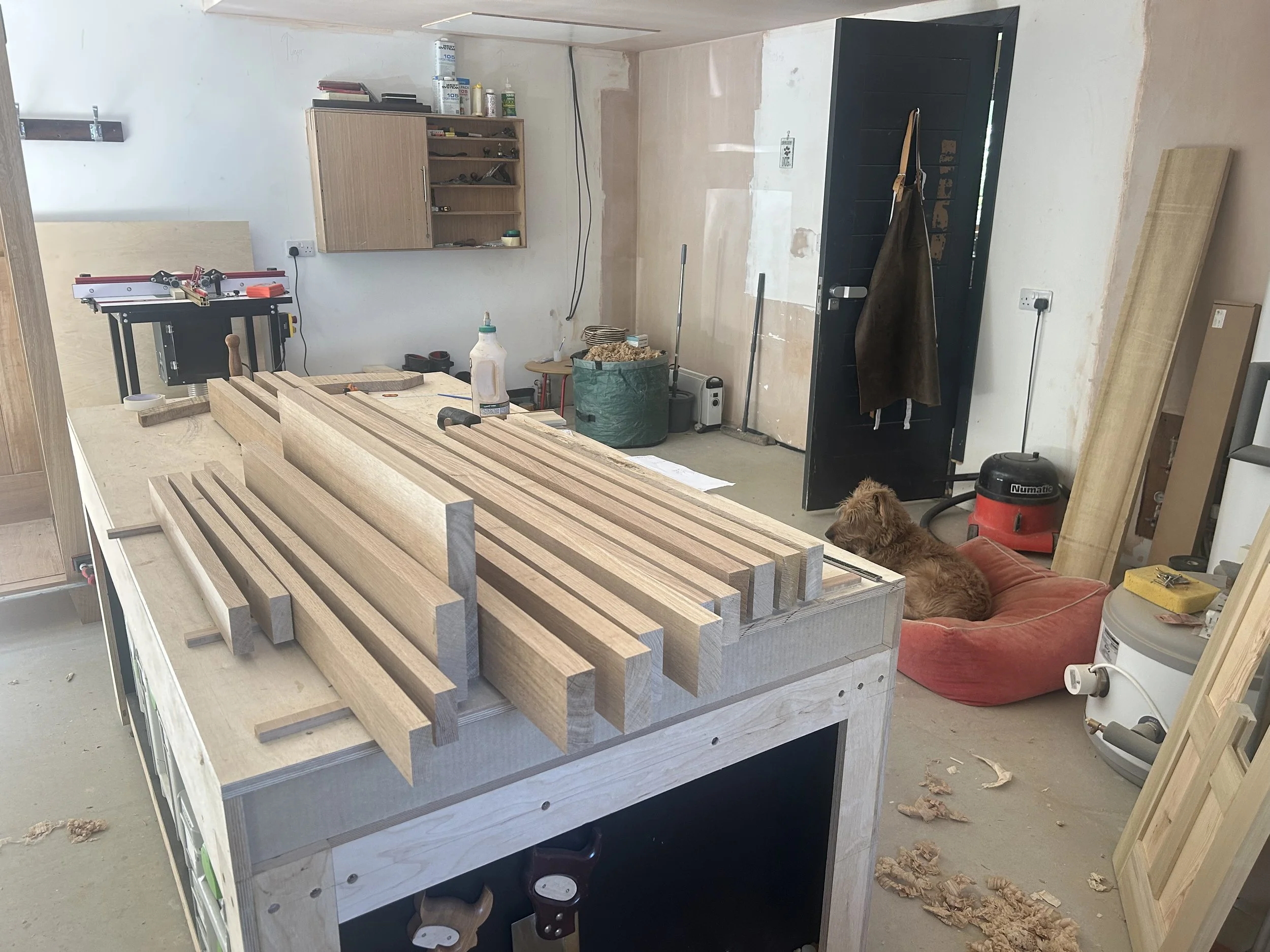
Everything starts with processing the rough sawn timber, flattening, squaring, allowing it to rest before repeating until the movement stops
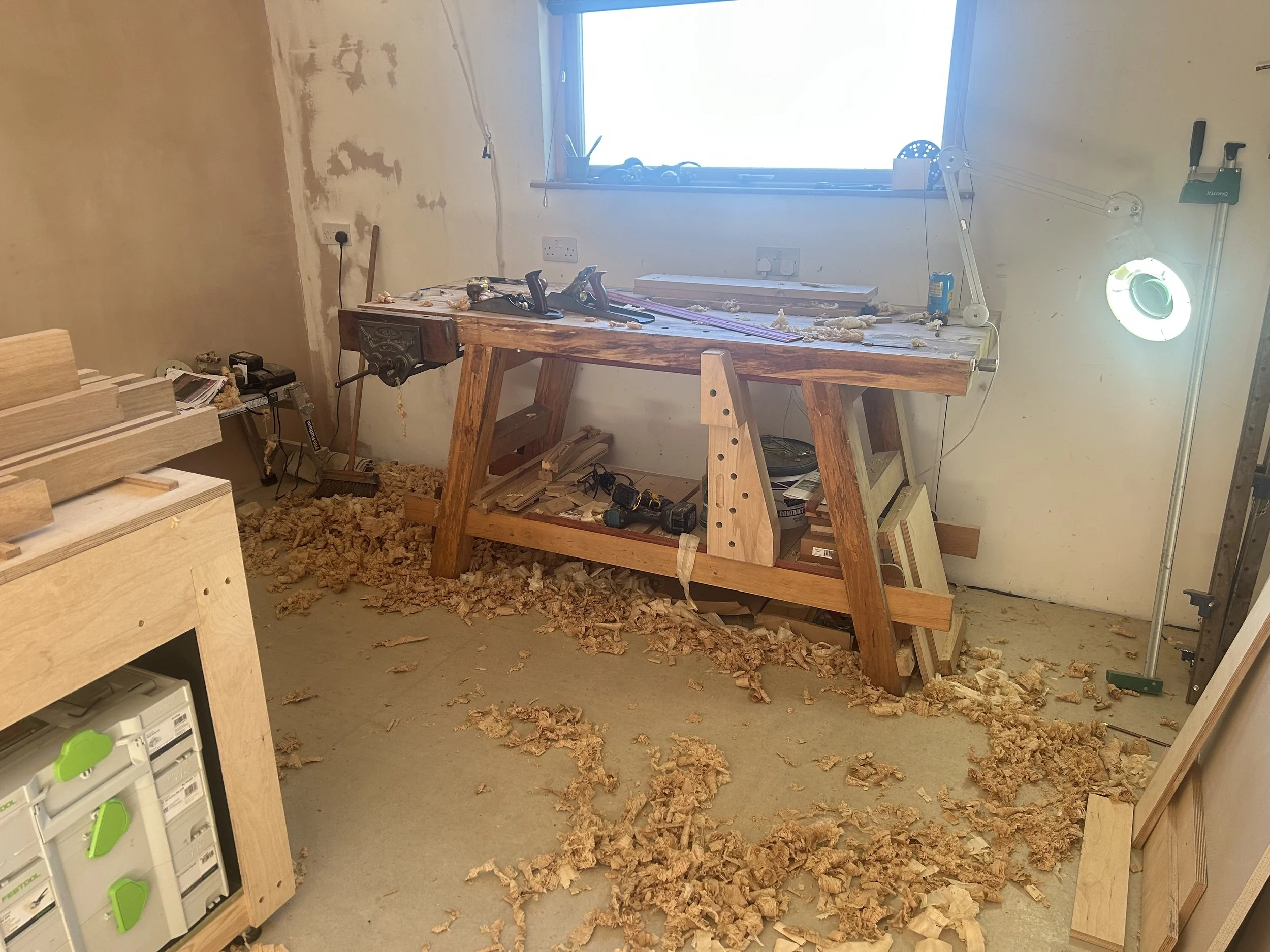
Wood shavings are a woodworker’s glitter
But it was during those visits that the commission became what it truly was. Michael recounted stories of his late wife Sheila. The wardrobe wasn't just a gift to the church — it was the memorial of a man's dedication to his wife and his faith.
And then, almost in passing, he mentioned that she had loved mice. Robert Thompson's mice specifically — those small carved signatures that the Mouseman of Kilburn has been leaving on furniture since the 1920s. Sheila had two cherished napkin rings, a carved mouse sat on each one. After Sheila passed, Michael gave one of her carved napkin rings to her niece Caroline.
I filed all this away and said nothing. But I knew immediately that a mouse had to be part of this wardrobe. The question was how?
Now, I should explain something about where I live and work. My workshop overlooks Robin Hood's Bay, on the North Yorkshire coast. On a clear day from my bench I can see for miles across the grey North Sea. I can forecast the weather from my bench — it may not be my quotation but, if I can't see the horizon, it must be raining, if you can see the horizon it's going to rain!
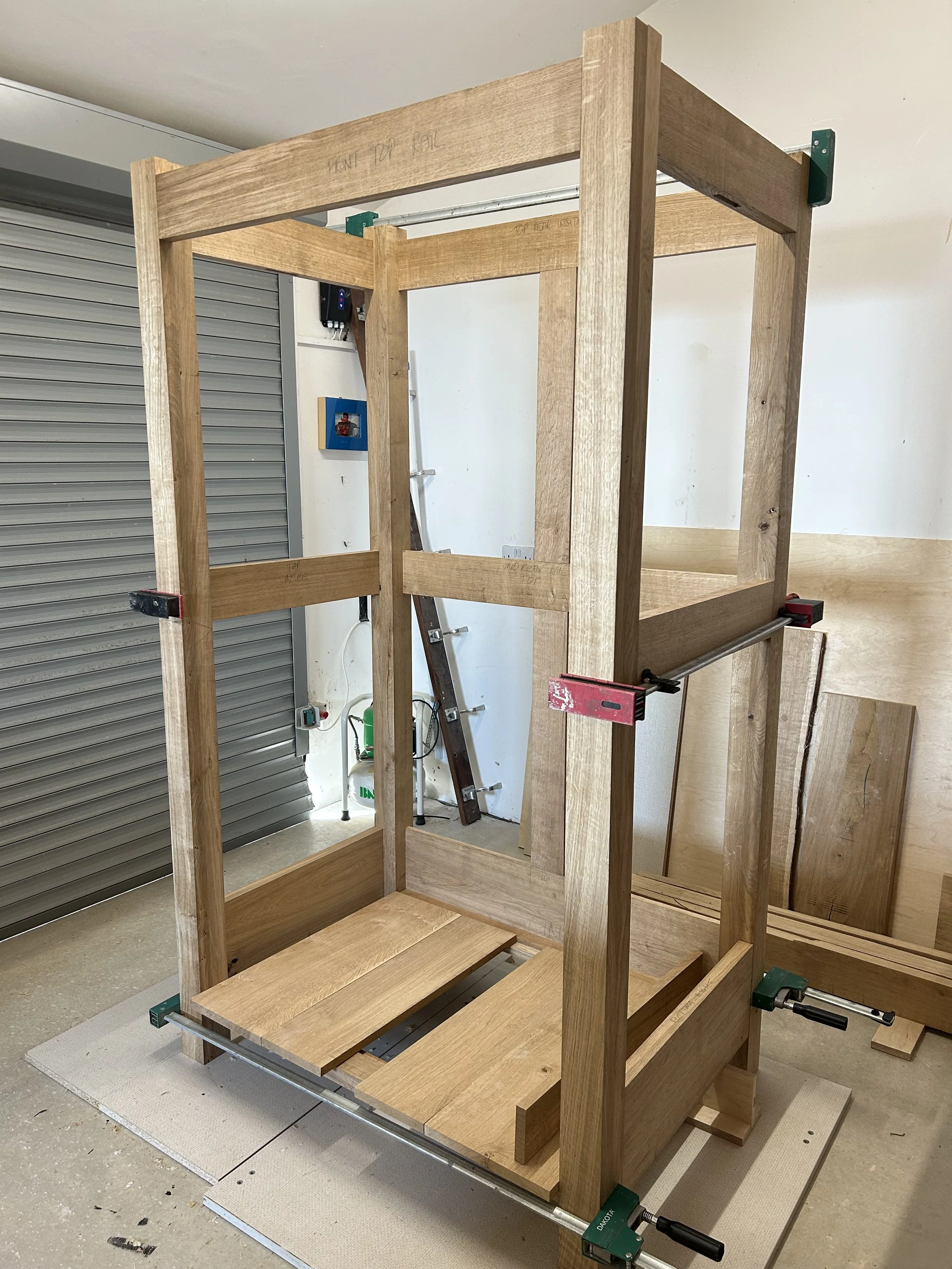
First dry fit of the sides
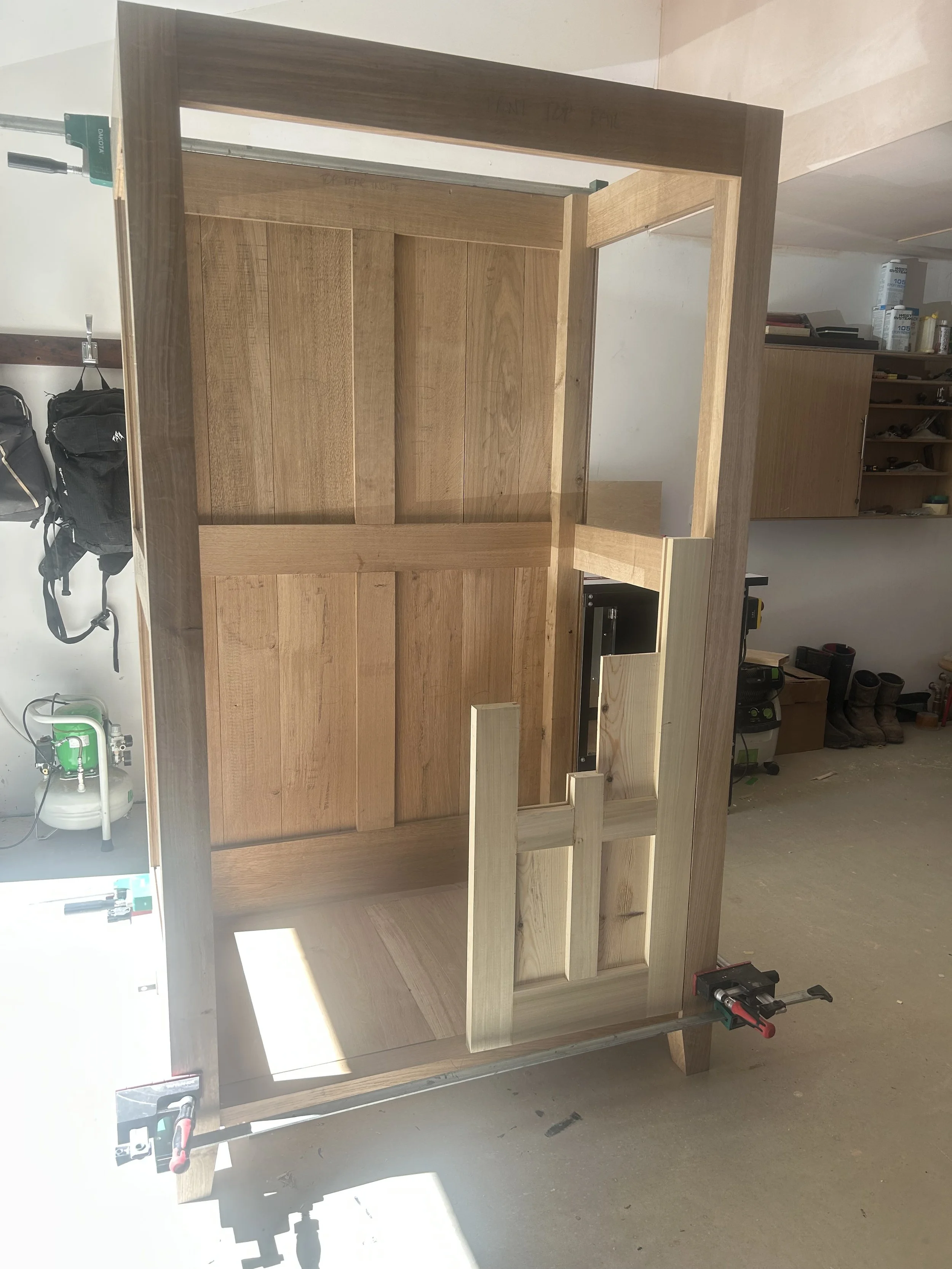
Completed rear panel with expansion joints and a door template to check scale
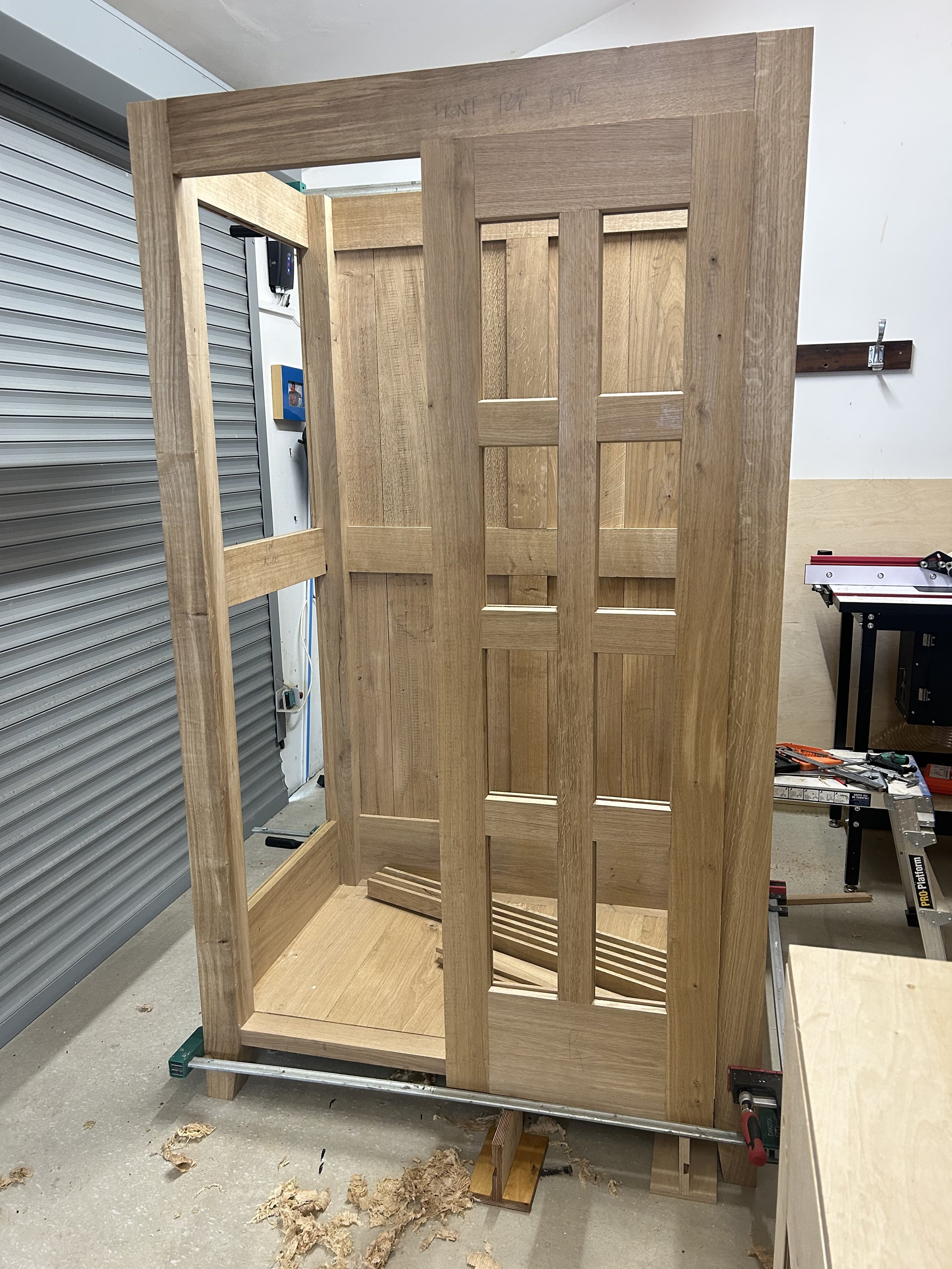
First door fitting, unglued and without the inner floating panels.
And thirty-seven miles inland as the crow flies, in the village of Kilburn, is something every furniture maker in Yorkshire knows about. The workshop of Robert Thompson, the Mouseman.
Since the 1920s, every piece of furniture that leaves that workshop has carried a small carved mouse as its signature. It's one of the most recognised marks in British craft. Understated, hidden, waiting to be found. If you've ever run your hand along a church pew in a Yorkshire church and felt a small bump — that was probably a mouse.
Everyone in Yorkshire knows about the Mouseman. We talked about carved mice, we laughed about it together. And I told him the truth — that as much as I'd love to carve a mouse into his wardrobe, I couldn't. Carving isn't part of my skillset. And even if I tried, even if it turned out reasonably well, I'd probably receive a very polite but firm letter from Kilburn asking for it to be removed.
We laughed about that too.
But the mouse stayed in my mind. And then the answer came from the most obvious place — I just hadn't been looking there.
Michael lived in a former blacksmith's cottage in the village. And as I looked around at the commission — the church, the cottage, the brief — I found myself thinking about iron. About steel. About things made by hand in fire rather than shaped by blade.
I knew a man. A local blacksmith, not from the pub this time, his reputation preceded him. I picked up the phone.
We talked through the brief together. What started as a conversation about a clothes pole became something much more considered. I'd been to St Stephen's Church by this point, walking around it with a notebook, looking at everything. The vestry door stopped me. It was hung on traditional strap hinges — long iron straps reaching across the timber, blackened with age. Simple, functional, beautiful. The kind of ironwork you don't see anymore because nobody asks for it.
I asked the blacksmith if he could make me three pairs for the wardrobe doors. Not copies — interpretations. Hinges that echoed the vestry door without pretending to be something they weren't. He could.
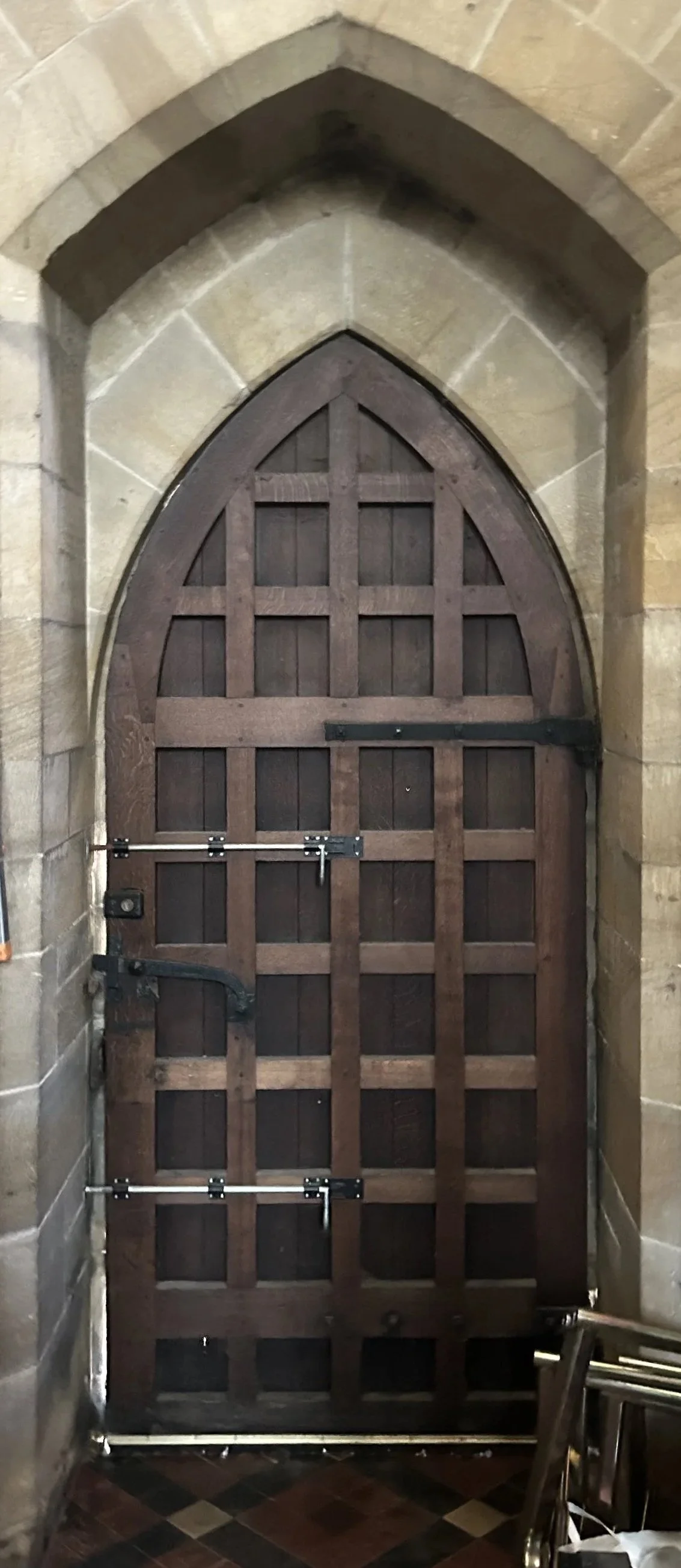
The Vestry door that inspired both mine and the blacksmiths work.
The doors themselves are traditionally panelled, inspired directly by that vestry door. And then there were the handles. The columns inside St Stephen's are faceted — cut into flat planes at angles, octagonal I think. I asked the blacksmith if he could forge the handles in the same spirit. Simple faceted steel, blackened and aged, referencing the church without shouting about it. He could do that too.
The wardrobe was finding its own language. Everything was coming from the place it was going to live.
And then we talked about the mouse. I'd considered a flat steel plate on the outside — a mouse image etched into the metal. But every time I imagined it, I felt the same thing. Too obvious. Too eager. This wasn't a decoration. It was a memorial. It needed to be private. It needed to be found rather than displayed.
The answer was the clothes pole.
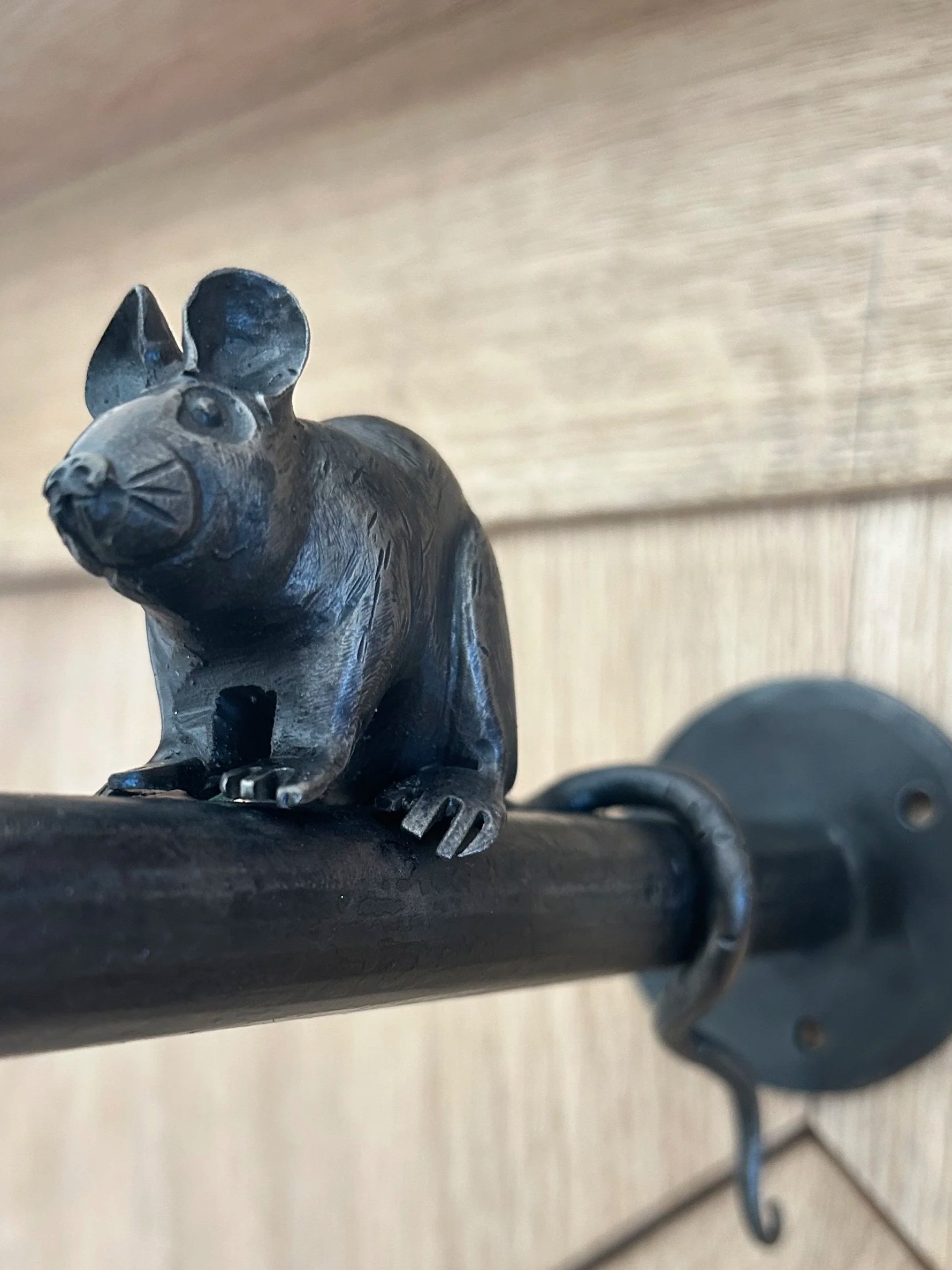
One forged mouse - tick
A small steel mouse, forged by hand, sitting inside the wardrobe on the clothes pole. Not on the outside where everyone could see it. Inside, in the dark, where only someone opening the wardrobe and really looking would ever find him. You must engage with the wardrobe to meet the mouse. You have to open the doors, step close, look up. And there he is.
I told Michael. He didn't say much. He didn't need to.
There was one more problem to solve. And this one nearly stopped me.
When I decided to incorporate ecclesiastical arches into the side panels — echoing the architecture of St Stephen's — I had a problem with the oak. To make a proper arch, you want the grain of the wood to follow the curve. It looks right. It behaves right. It won't fight you over time the way straight grain does when you ask it to describe a curve.
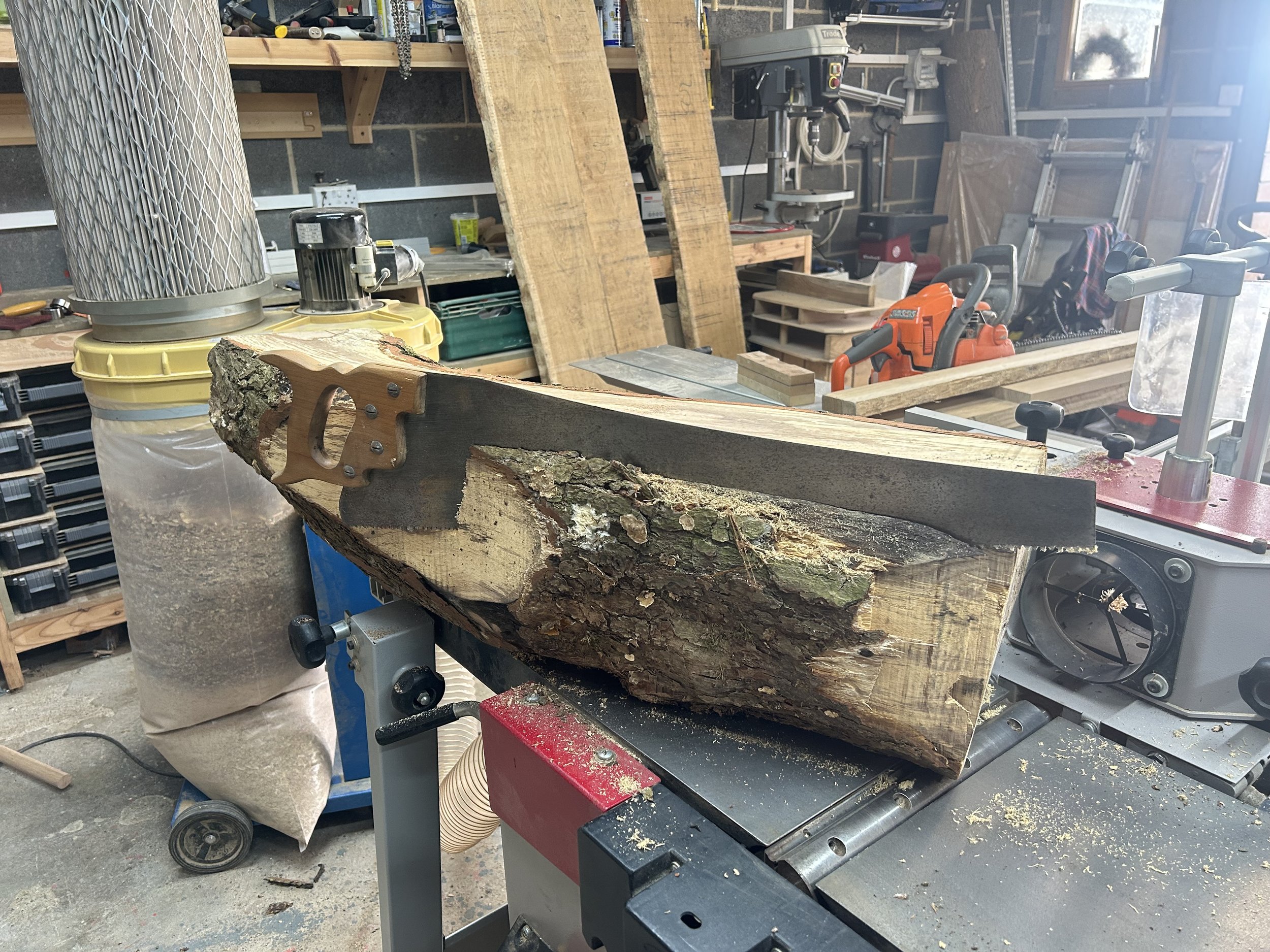
Stubborn and intransigent and that’s just Dougal!
But modern sawmills don't sell bent oak. Nobody asks for it. Everything comes out straight, dimensioned, predictable. The world has decided that wood should be convenient.
I've never been very interested in convenient.
There's a tradition on this coastline that understood curved grain long before I did. The fishing cobles — those beautiful clinker-built wooden boats that have worked these waters for centuries — are framed with curved oak ribs, each one shaped so the grain follows the curve exactly. Every shipwright on this coast knows that the grain isn't just aesthetic. It adds strength precisely where it's needed. It's a very local piece of knowledge, and it felt relevant here. An arch, like a rib, needs to be right through and through — not just on the surface.
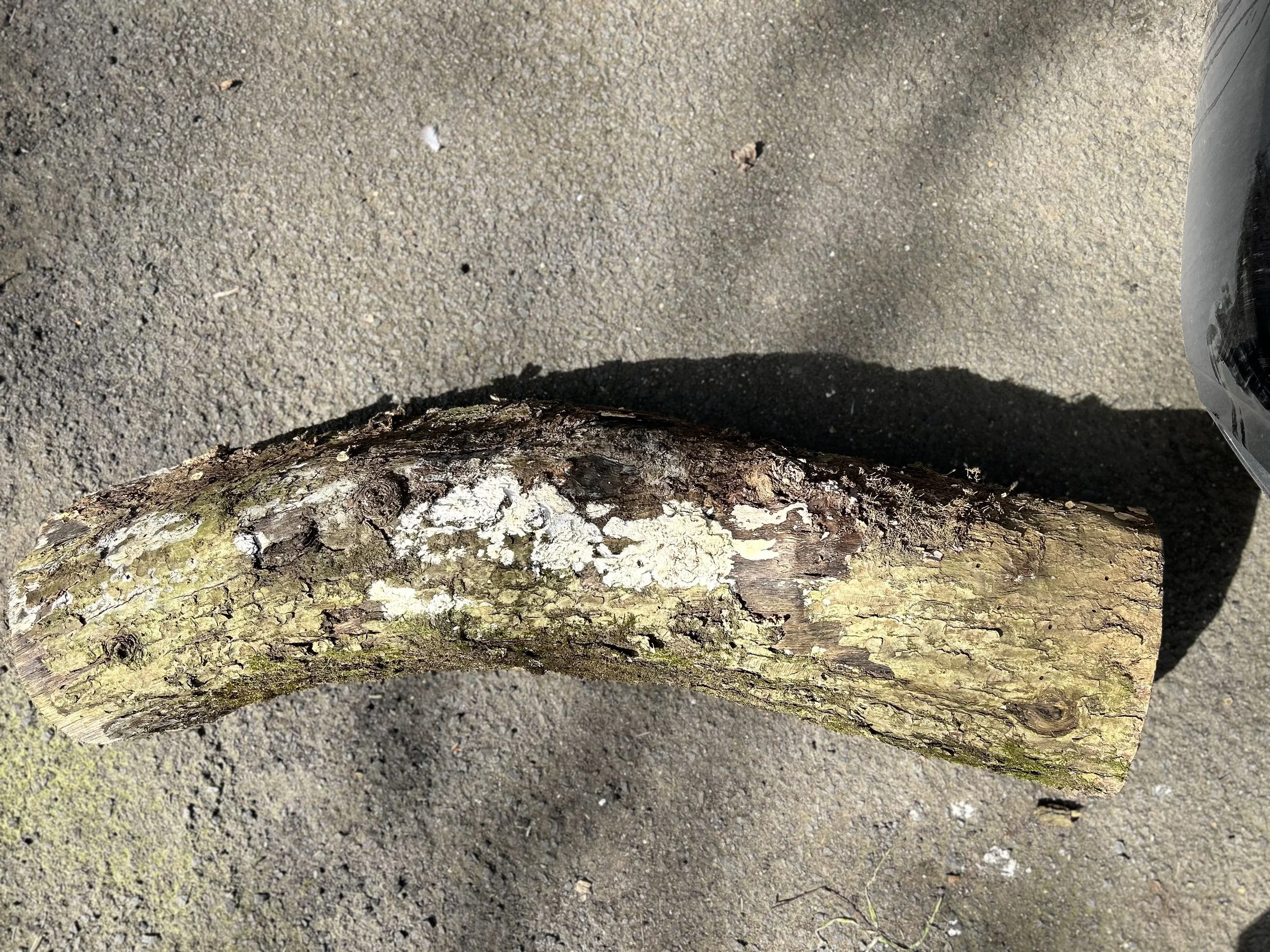
I knew a man. A tree surgeon this time, not a blacksmith. I'd met him — and I suspect you can guess where — in a pub. He had a yard full of felled timber. Bent pieces, crooked pieces, the awkward ugly wood that nobody wants. He told me to come down, take what I needed, and chainsaw it myself.
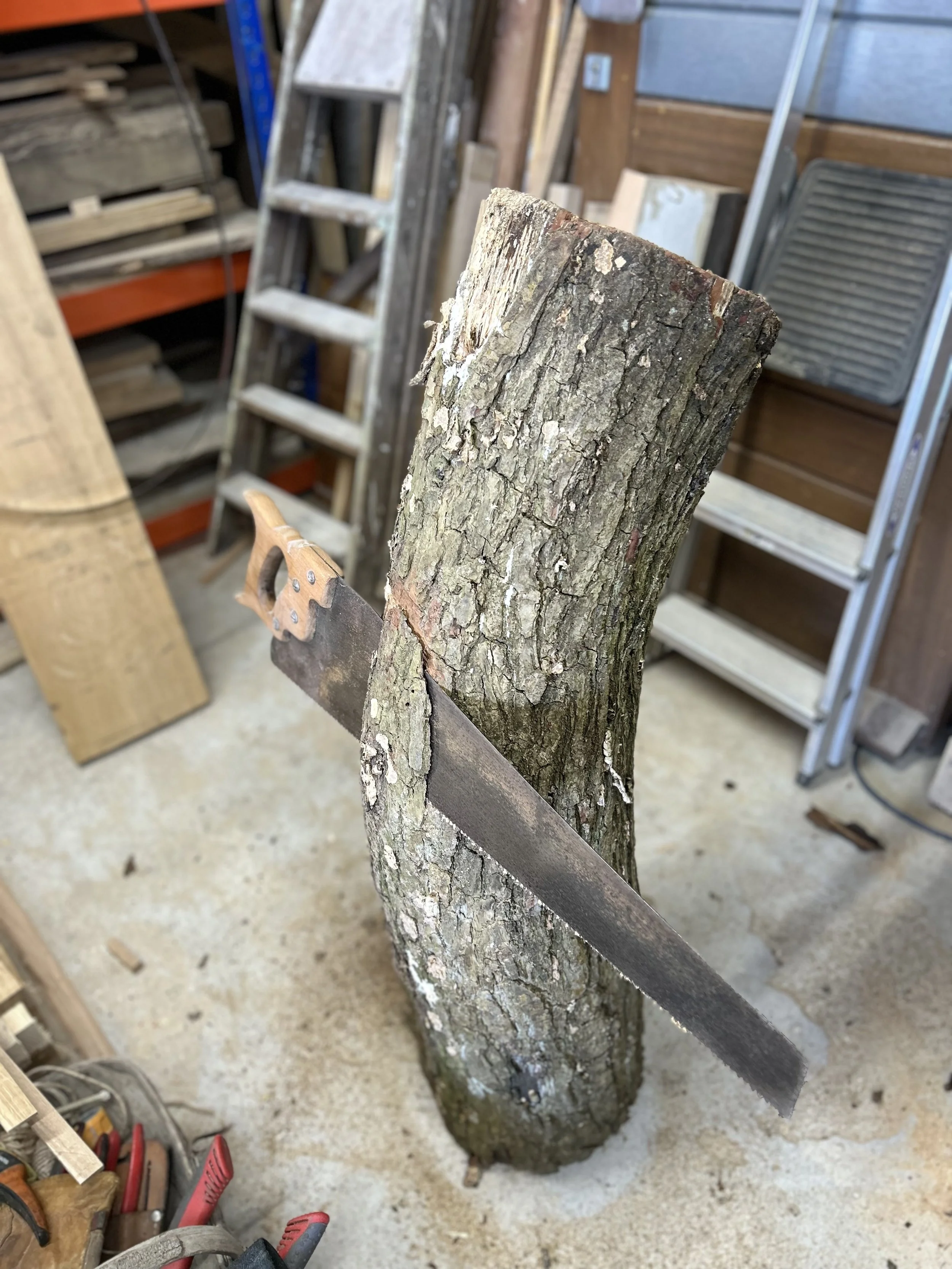
So I did. I found what I thought was my curved oak. Chain sawing the elbow across the grain and then ripping into planks using a hand saw, leaving curved wet planks. I sticked the planks, closed the door on the kiln and waited.
And then the wood said no.
Placeholder image
When I came to flatten the pieces, I found them full of inclusions — knots, staining, faults running through the grain that made them unusable. All that effort. All that romantic notion of locally sourced curved oak following the arch exactly as nature intended — I wonder if the shipwrights were as fussy!
This is the thing about working with timber that nobody tells you when you start. Wood is never the servant. It is always the master. You can plan, source, prepare, and hope — and then a piece of oak that looked perfect will simply refuse to cooperate. There's no arguing with it. There's no forcing it. You accept the decision and you find another way.
Against my better judgement, and with no small amount of disappointment, I went to the sawmill and bought straight oak. I tormented myself about this. The story I'd wanted to tell was a better story than the one that actually happened. But furniture makers who tell better stories than true ones don't last long. The wood always knows. And so, I suspect, do the people who commission the work.
The arches are in the side panels. They're right. The oak is good and true. And somewhere in my workshop there's still a piece of bent, knotted, stubborn European oak that beat me — and that I'll probably try again with one day, just to see.
But I haven't been entirely honest with you. The curved oak failure wasn't just a setback. It came at a moment when everything felt precarious.
It was the middle of winter. The commission was weighing on me in ways I hadn't anticipated. My marriage had ended not long after I'd taken the job on, and the workshop — which had always been my sanctuary — felt suddenly very quiet and very cold. I had huge reservations about my ability to finish the piece. A crisis of confidence, if you want to dress it up. A wobble, if you don't.
I found myself with no one I felt I could share this with. Not appropriately, anyway. And then I looked at my son Arthur, who was thirteen years old, and I made a decision I've thought about many times since — I told him the truth. That I was struggling. That I wasn't sure I could do it.
I probably shouldn't have burdened him with it. He was thirteen.
But in one sentence he went from boy to man.
He looked at me and said: "Just sit down, calm down, and think only about the work in front of you. Dad — if I know anyone in this world who can finish that wardrobe, it's you."
That was it. No fanfare. No lengthy reassurance. Just absolute belief, delivered simply, by someone who had no reason to say it other than the fact that he meant it.
Only a son can make you feel that good about yourself.
Everything from that moment forward was a little bit easier.
Michael visited the workshop recently to see the finished wardrobe. He was quietly respectful. Complimentary without being gushing. He mentioned the arches, the doors, the hinges. He seemed to find the mouse in the right spirit — private, considered, where it should be.
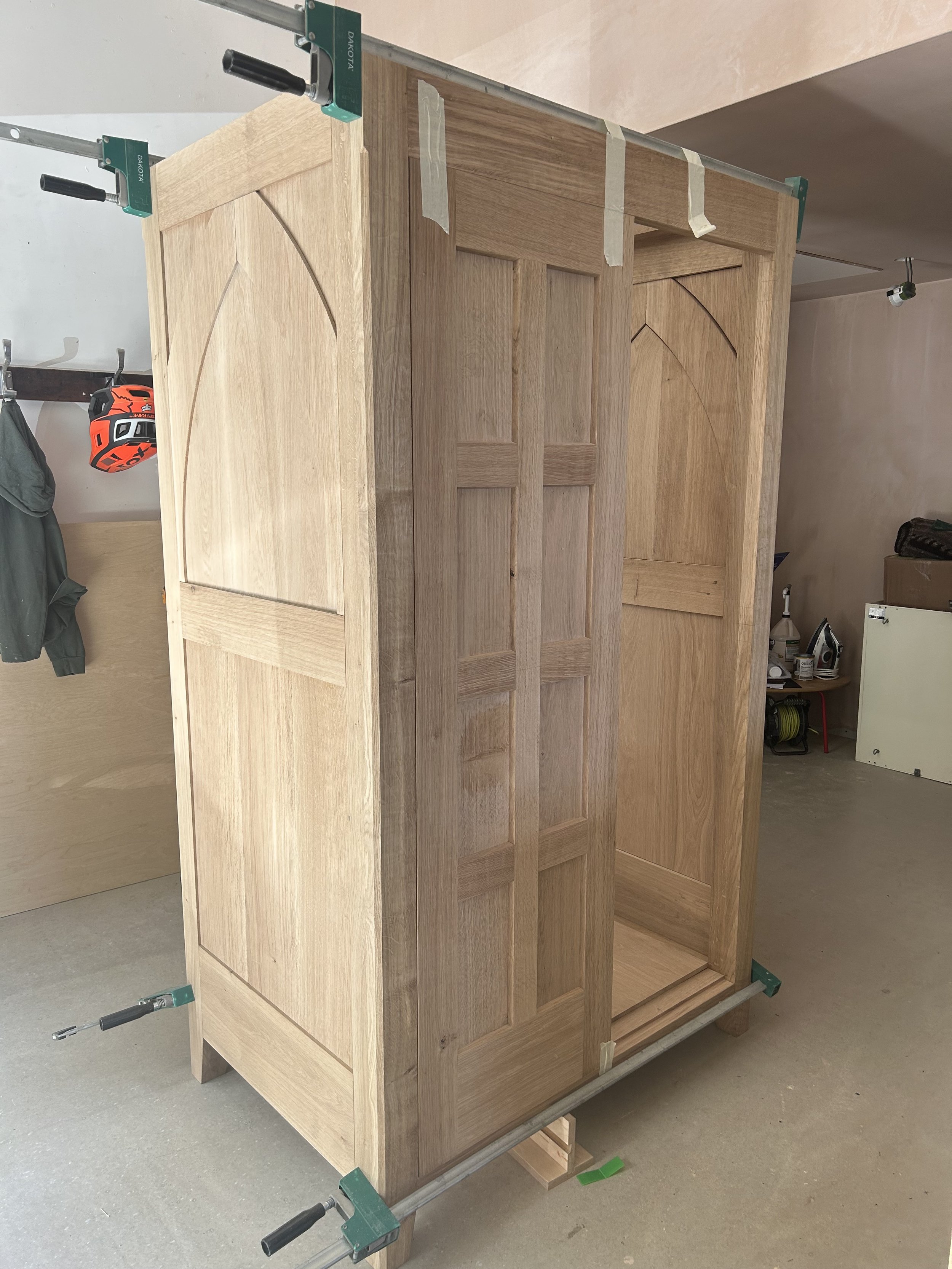
The arches take shape and the doors are ready to be hung.
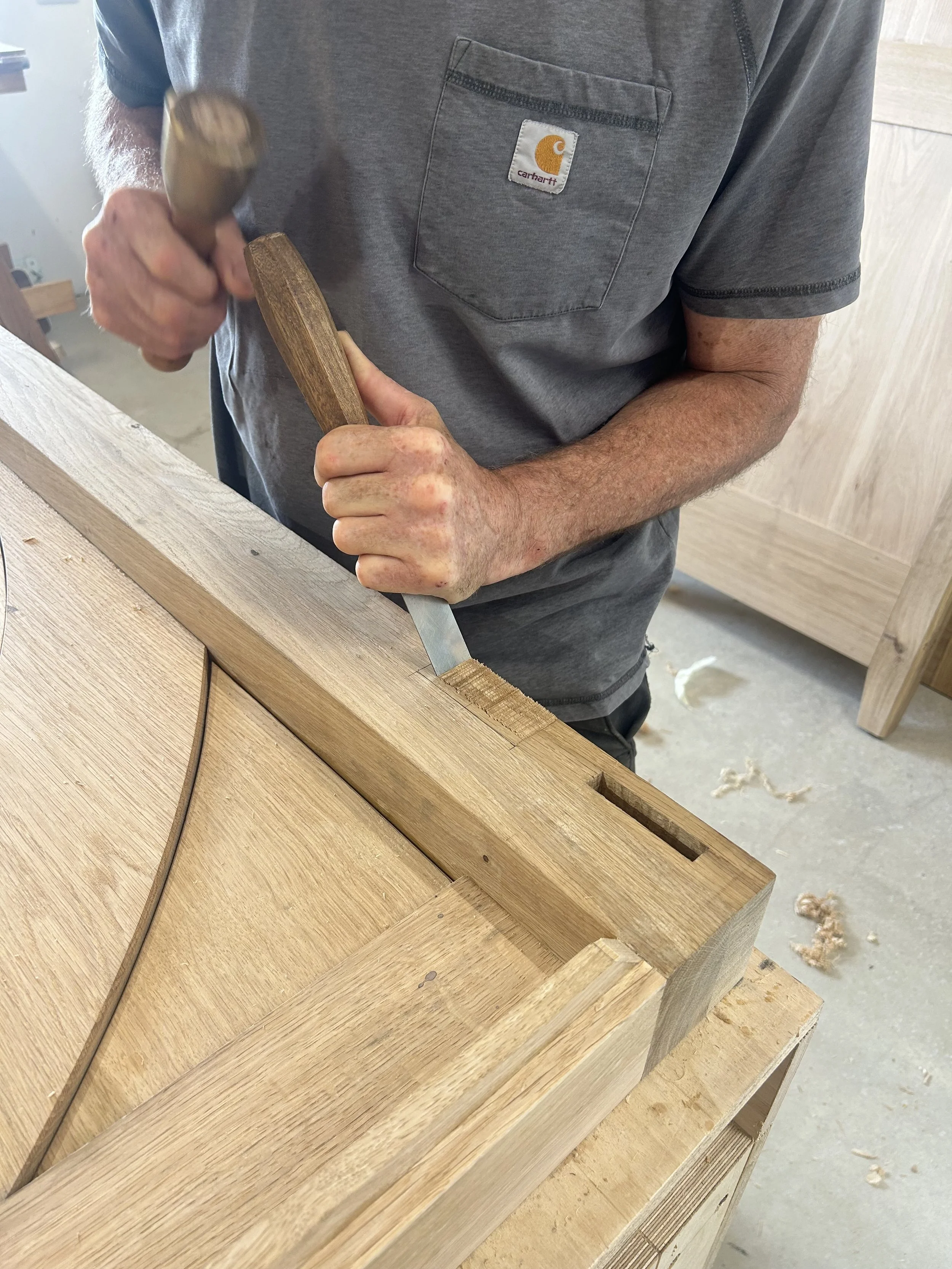
The hinges, being hand forged, required all six to be individually fitted to ensure to doors enjoyed perfect gaps
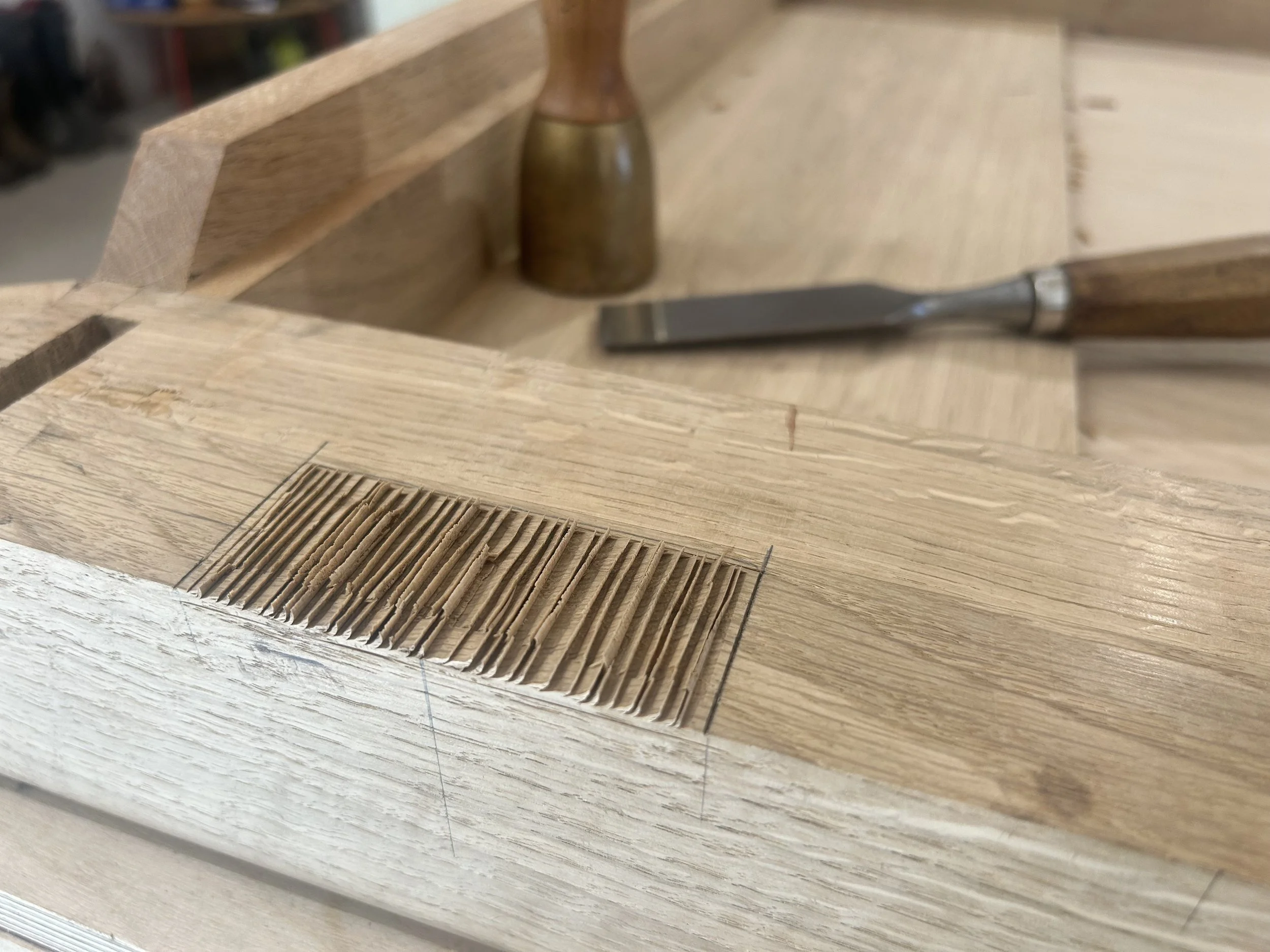
Fitting each hinge required precision and patience.
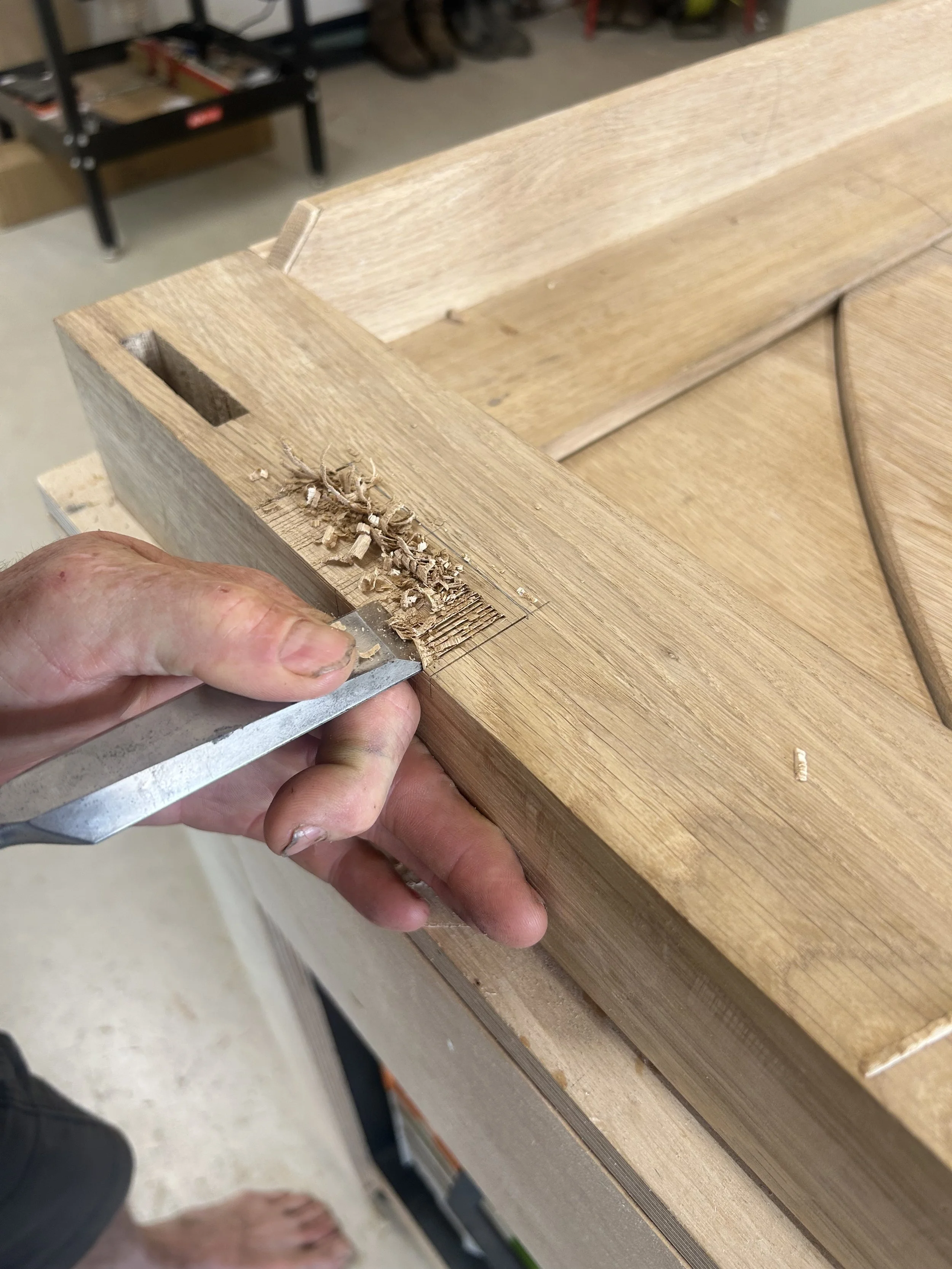
A nice picture of the traditional pinch grip, allowing precision while ensuring ultimate safety
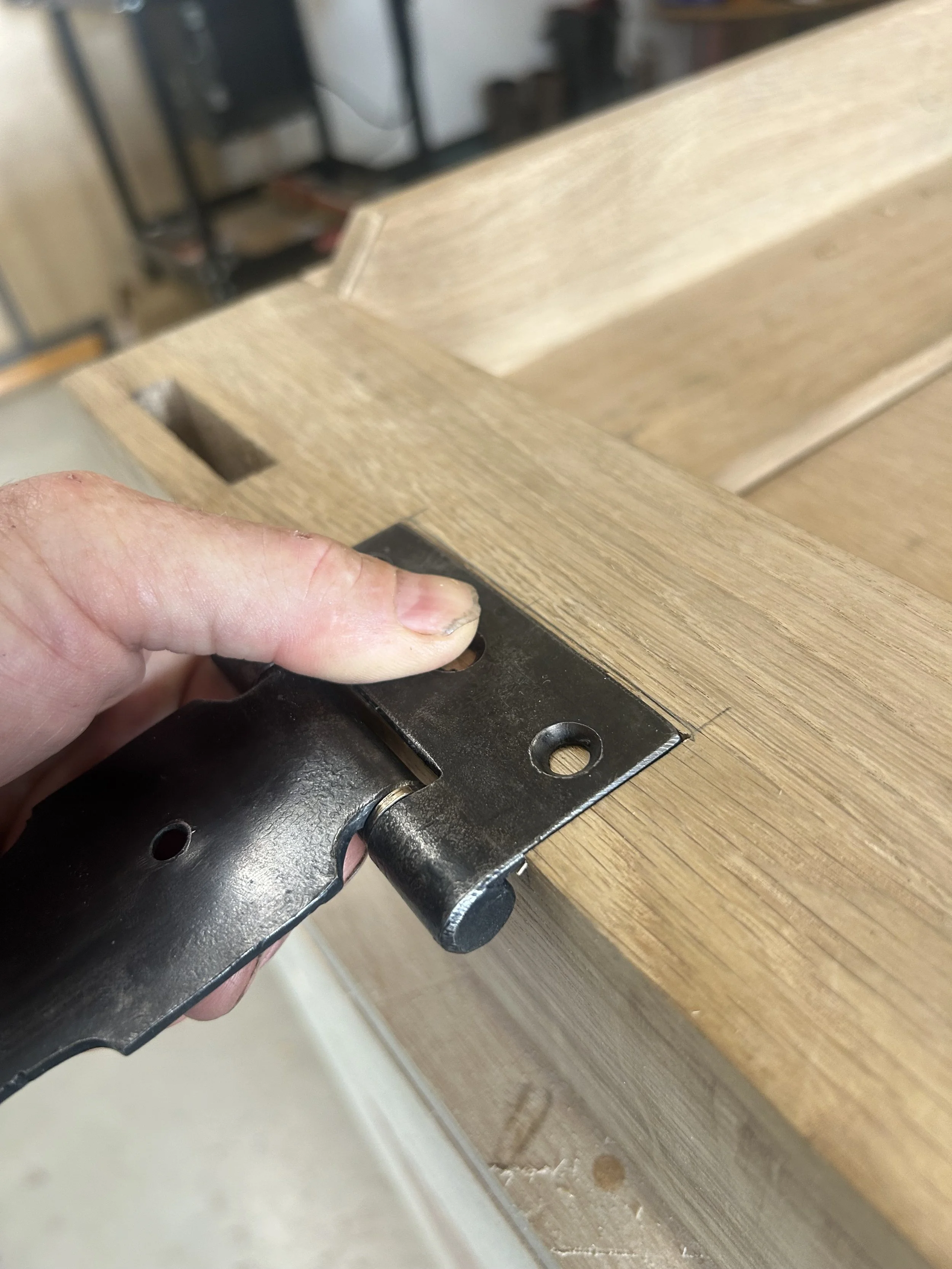
One down, five to go!
He left me slightly discombobulated if I'm honest.
When you're in your nineties, when you've spent a lifetime in the church, when you've recently lost your wife — you're not going to stand in a workshop and gush over a wardrobe however much it means to you. Michael is from a different era. He said the right things quietly and then he left. I respected that. But I still stood there afterwards wondering.
I mentioned to my son Arthur that I felt a little crestfallen. He understood.
You become attached to a piece of work. Especially one like this. And then suddenly it's leaving — and that's the moment you realise it was never really yours. It belonged to Michael and Sheila and St Stephen's Church from the very beginning. I was just the person who made it.
On the 5th of July, Rev. Michael Waters donated this wardrobe to St Stephen's Church in Fylingthorpe. There will be a short service. Local people, churchgoers, representatives of the diocese. It was a quiet occasion, as the best occasions tend to be.
The day itself started on the Saturday. With the help of two good friends we lifted the wardrobe out of the workshop and into the van. I drove the short distance to the church, and we carried it into the vestry. I still had work to do — the back panels, roof, and floor had been removed for transit to reduce the weight. Once everything was fitted, the doors hung and squared, the wardrobe levelled on the slightly uneven stone floor, I left it to rest overnight.
On Sunday morning Arthur and I arrived just before the service, took our place in the pews, and sang our hearts out. At the end, the vicar explained to the congregation that Michael had kindly donated the wardrobe to the church. Then came the blessing.
Michael and three other local retired priests each carried one of the four vestments into the wardrobe in turn — red, white, purple & green — the colours define the ceremony or celebrations. Four men of the cloth, each placing something precious into something made entirely by hand. I'm not sure I breathed during any of it.
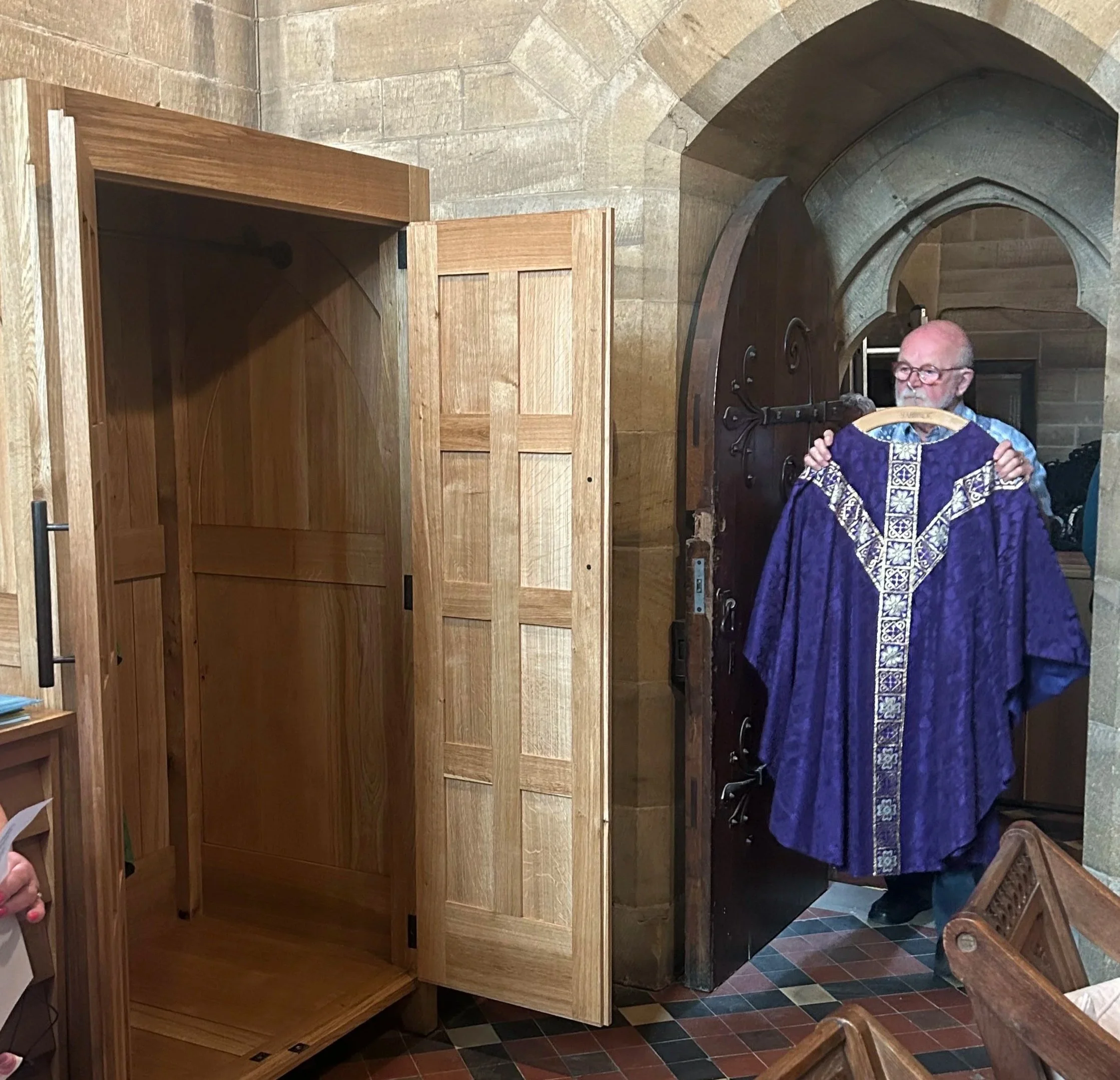
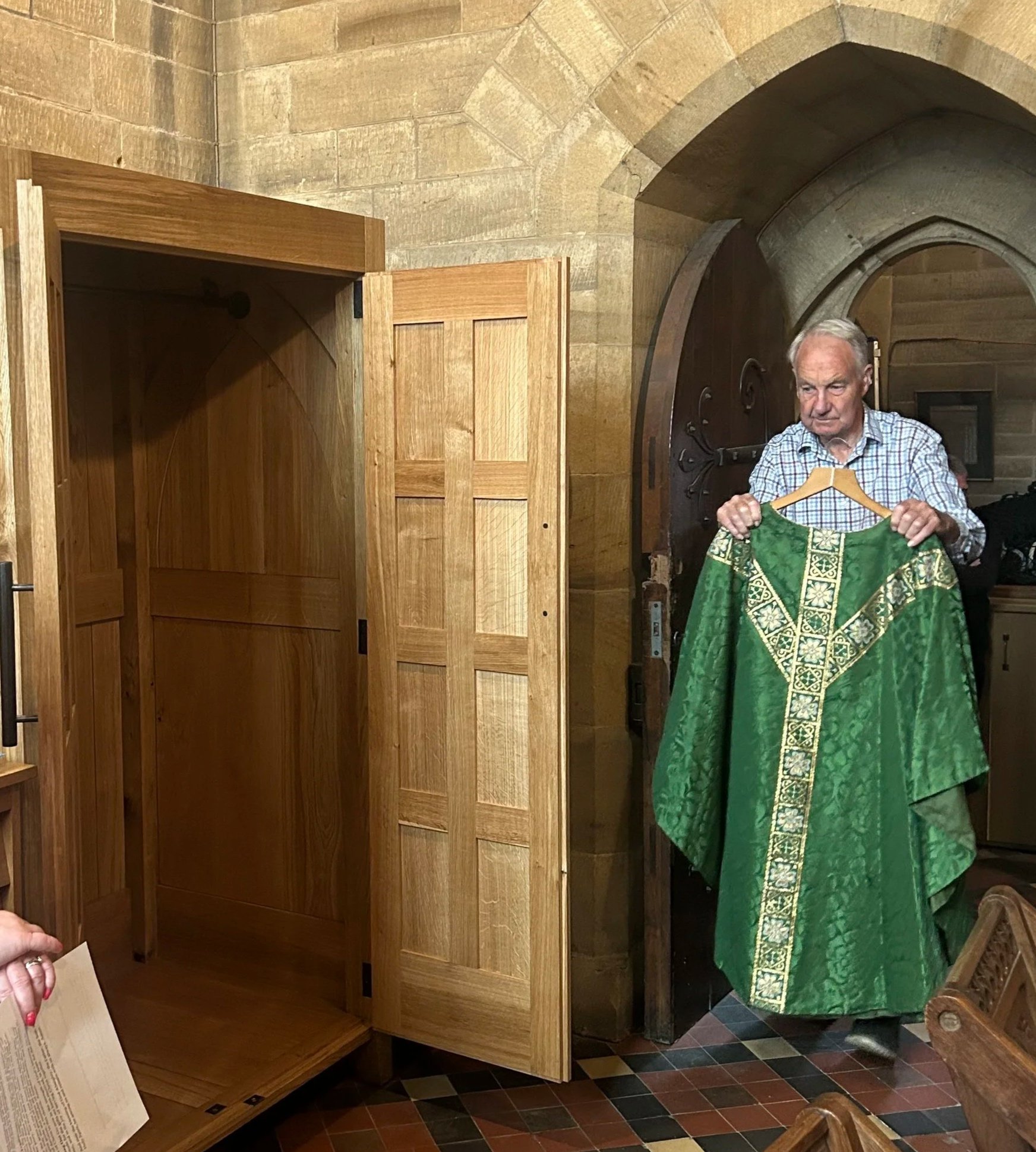
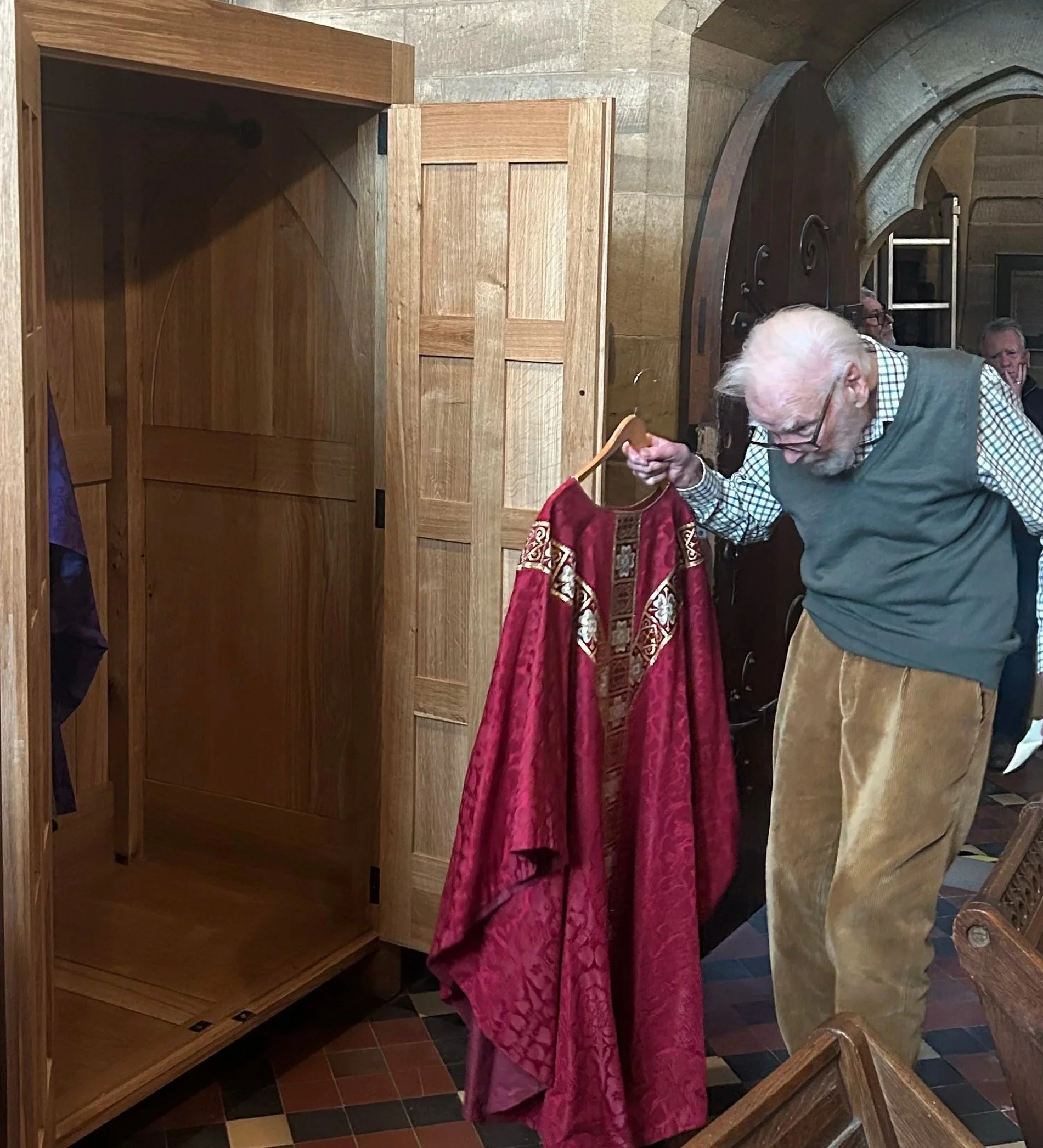
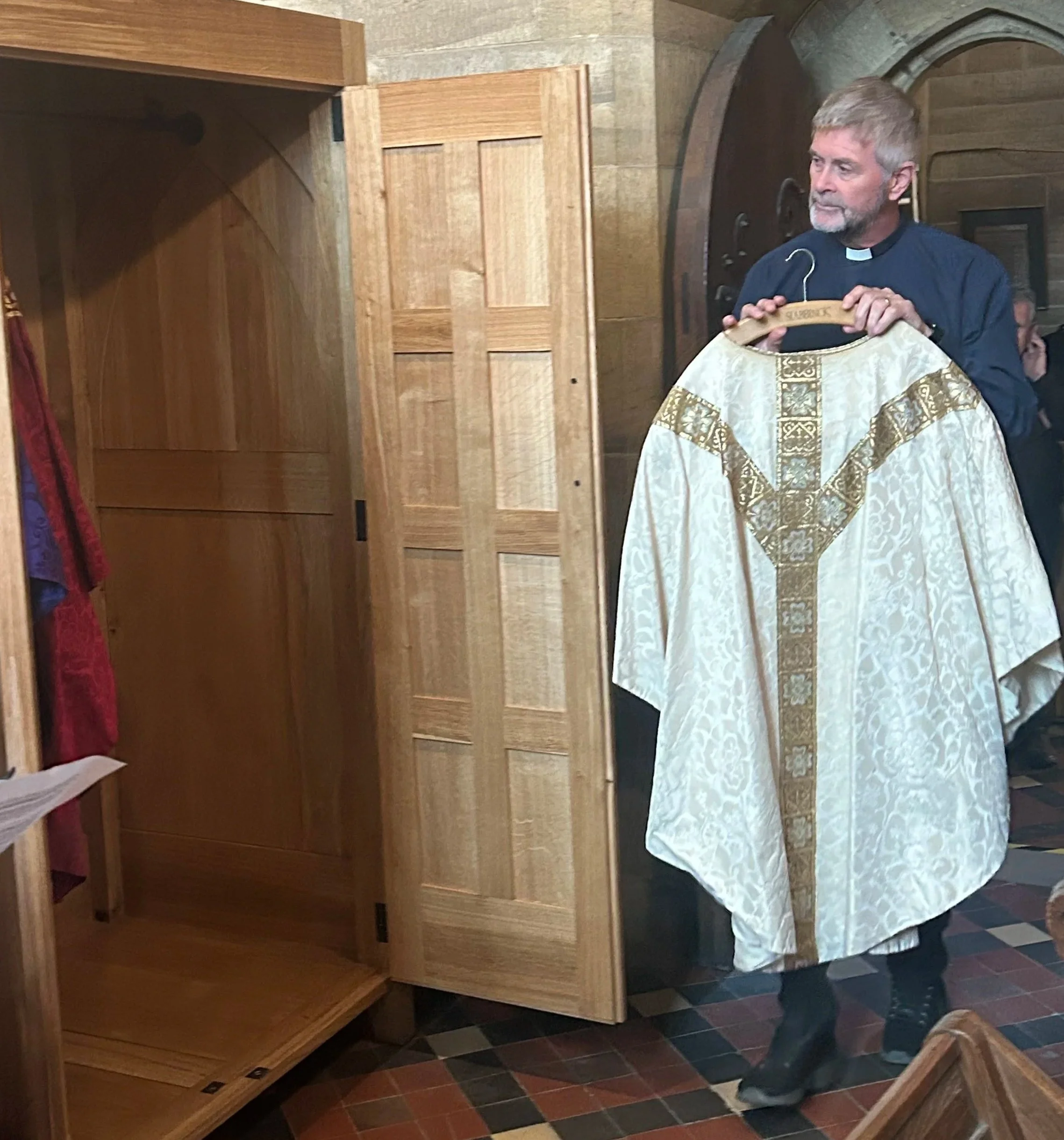
Afterwards the congregation filed past, cups of tea in hand. One or two played hunt the mouse. There was warmth in that vestry that had nothing to do with the radiator.
One of Michael's friends turned out to be a former woodwork teacher. My anxiety went to eleven. He gave the wardrobe ten out of ten and asked to visit my workshop. I exhaled.
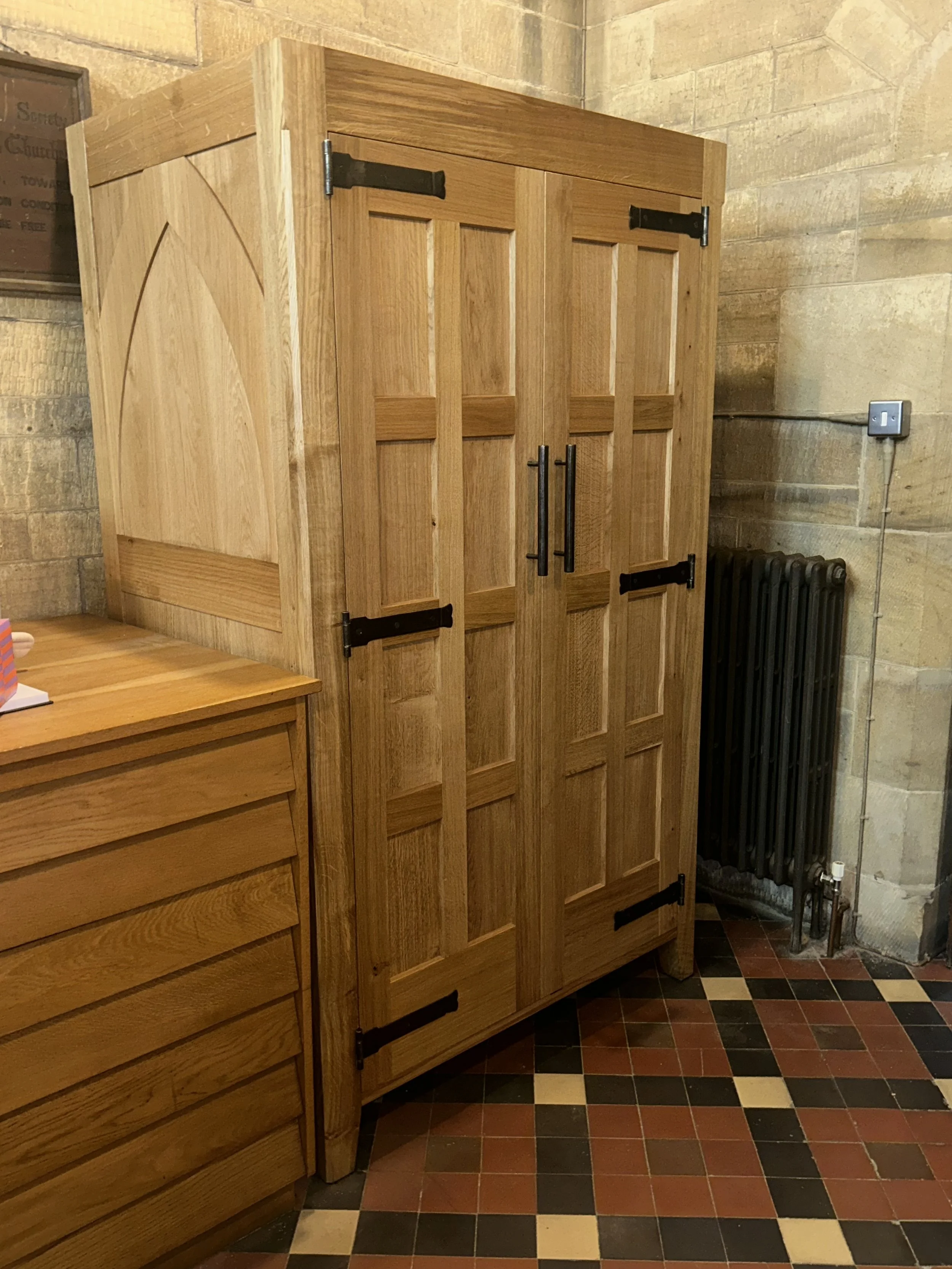
Michael remained reserved throughout — listening to others, not making judgement. I went home with Arthur wondering, as I had wondered after every workshop visit, whether he was truly happy or simply being polite. The workshop felt empty. The piece that had lived there for months was gone. I felt, if I'm honest, a little underwhelmed — not by the day, which had been genuinely lovely, but by the strange deflation that follows something you've worked toward for a long time.
Then on Monday, Michael called.
He was different. Charged. Enthused. He had listened to everything the congregation said, digested it quietly in his own time, and was now ready to speak. His words were warm, appreciative, and insightful. I believe Michael is very happy with the result.
And even in his praise he used the words of others. Arthur, it turned out, had spoken to Michael before the ceremony — without my knowledge — and told him that his dad had put his heart and soul into the piece.
That was good enough for Michael.
And if I'm honest, it was good enough for me too.
I'll be there. Dougal didn't bother, he's not one for pomp and ceremony, he prefers the beach! But then again, without Dougal none of this would exist. He was the one who unknowingly brokered the whole commission. The dog who started it all.
He remains entirely unbothered by this fact. He's that kind of dog.
A piece of handmade furniture doesn't tell you how good the maker is on the last day of the commission. It can wait decades before it reveals the true answer. That wardrobe will be in that church long after everyone who made it and commissioned it and loved it is gone. It will answer for itself in its own time.